Asana acquisisce StackAI: ora ogni flusso di lavoro uomo-agente viene eseguito in un unico posto.Scopri di più
Project management skills: 25 soft, hard, & technical skills



Summary
At Asana, we believe that if you manage projects, you're a project manager, even if that's not your job title. For teams to collaborate effectively and get their best work done, they need a project manager like you to lead the way. But even if you're already managing a project, or even multiple projects, how do you get better at being a project manager?
If you're interested in honing and developing your project management skills, you're in the right place. In this guide, we'll cover 25 key skills you need to succeed as a project manager or project administrator, and how you can develop those skills over time.
What are project management skills (and why do they matter?)
Project management skills are the abilities that help you plan, execute, and deliver projects successfully. They fall into three categories: soft skills such as communication and leadership, hard skills such as project planning and scoping, and technical skills such as using project management software.
Soft skills: Interpersonal abilities like collaboration, communication, and adaptability
Hard skills: Quantifiable abilities like project planning, scoping, and timeline management
Technical skills: Tool-specific knowledge, like Gantt charts, Kanban boards, and workload management
Project management is the practice of organizing and executing work efficiently, and helping your team do the same. Traditional project management tools were hard to set up and required constant maintenance, which is where the position "project manager" comes from.
Modern project management tools
Modern project management evolved from traditional project management in two distinct ways. As companies and teams democratized their project management processes, they needed more team members and team leads who could manage projects from conception to completion. In order to support those team leads, project management software has also evolved, from complex mechanisms to flexible and easy-to-use tools.
![[Interfaccia utente del prodotto] Esempio di progetto per le richieste di lavoro (Bacheche)](https://assets.asana.biz/transform/21435617-135c-46b0-8c0f-bc69ef6cae0c/Work-Requests-Template?io=transform:fill,width:2560&format=webp)
Today, any team member may be called upon to run a project and serve as the de facto project manager, which is why modern project management tools are designed to be flexible enough for anyone to use on any project. These tools, like Asana, make it easy to track, manage, and organize work without the steep learning curve of traditional tools. With today's project management tools, you can easily implement project management best practices and bring a new level of clarity and visibility to your project team.
How to use your project management skills
Project management tools do the heavy lifting in reducing silos, increasing visibility, and facilitating cross-functional collaboration. As the project manager, you can use these tools to give your team the insights they need to do their best work. While you don't need to learn complicated skills or tools in order to become a successful project manager, there are hard, soft, and technical skills you can develop in order to improve your management and collaboration skills.
Some of these skills might not apply to you, while others might be things you're already seasoned in. Like everything in the five phases of project management, approach this list with flexibility and work on the skills that are most relevant to you.
10 soft skills for project managers
Soft skills, also called "people skills" or "interpersonal skills", help you work with and relate to others without requiring a specific tool or technical knowledge. These 10 soft skills are essential for project management:
Collaboration
Teamwork
Communication
Time management
Leadership
Organization
Problem solving
Critical thinking
Adaptability
Conflict resolution
1. Collaboration
Collaboration is the cornerstone of all project management skills. In project management, collaboration helps you get work done quickly and more efficiently. When you can coordinate across teams, you gain valuable insights into your project that you might not find within your team.
To improve your collaboration skills, practice having conversations. Use techniques like active listening, where you stay engaged and focused when others are speaking. Learning how to have open communication and reduce boundaries is critical for a collaborative team.
2. Teamwork
Everyone on your team has something to bring to the table, and your team is more effective working together than they would be alone. Teamwork ensures that everyone feels welcome, valued, and supported to contribute.
If you're working to boost your teamwork skills, dig deeper into team brainstorms, 1:1 conversations, and ask for feedback from your team. Notice if there's someone who hasn't spoken up in a while, and be supportive when another team member has a new idea.
Leggi: Dieci semplici passaggi per aumentare la collaborazione all'interno del team3. Communication
Miscommunications are common when you're working with a group of people. Learning how to communicate well and avoid these will make projects run more smoothly and be more enjoyable.
To develop your communication skills, practice being open and honest with your coworkers. This requires a lot of trust between you and your team members. To build this trust, encourage your team members to share their thoughts in discussions, even if you disagree.
4. Time management
Time management and organization skills go hand in hand. As you become better at organizing your tasks, you'll also have a clearer sense of everything that's on your plate and how long your upcoming tasks are going to take.
Still, it can be hard to buckle down and prioritize your work. To improve your time management skills and reduce procrastination, try prioritizing tasks. When you're clear on which tasks are higher priority, you can tackle them first to make sure nothing falls through the cracks.
5. Leadership
Even if you don't think of yourself as a leader or have a role in team management, when you're managing a project, your project team is looking to you for leadership, guidance, and support.
To develop your leadership skills, practice approaching situations with empathy and understanding. Good leaders bring everyone together and make them feel supported, fostering teamwork and collaboration.
6. Organization
For many project managers, organization feels like an innate trait; you either have it, or you don't. But like every other skill in this article, you can develop your organizational abilities with the right approach.
The best way to become more organized is to create a central source of truth for your work and your team's work. The average employee switches between 10 tools per day, which creates disconnection. Instead, use a digital organization tool to consolidate everything in one place.
Leggi: Come organizzarsi: 17 suggerimenti che funzionano davvero7. Problem solving
Problem-solving skills are collaborative, iterative skills that help you approach a problem and, ultimately, solve it. Developing problem-solving skills isn't about always having the "right" answer; rather, people with great problem-solving skills practice approaching problems from new perspectives.
To become a better problem solver, use data-driven decision-making frameworks or routine analyses. For example, if you need to boost sales by 10% over your competition, you can run a competitive analysis to determine where you currently stand in the market. Then, use that information to develop a new marketing strategy coordinated with the sales team.
Leggi: Usa queste strategie per trasformare il tuo team in un gruppo di problem solver capaci8. Critical thinking
Critical thinking, like problem solving, doesn't have a single "solution." You can't "win" at critical thinking, but you can practice approaching problems logically instead of making decisions based on emotions.
To practice critical thinking, ask yourself these questions:
How did I come to this conclusion?
Could there be another answer?
Am I being swayed by something other than factual information?
Emotional decisions aren't necessarily bad; some of the best decisions are ones we're passionate about. But critical thinking helps ensure you're approaching situations from the right perspective.
9. Adaptability
At some point, whether it's this project or the next one, aspects of your project plan will change. Maybe your deadline or priorities shift, and you need to adapt your workflow accordingly. Great project managers can pivot and adapt to new situations to keep their project team on the right track. Developing self-awareness and emotional intelligence helps you manage your emotions during times of change.
Leggi: Sei suggerimenti per aumentare la tua adattabilità sul luogo di lavoro10. Conflict resolution
Inevitably, conflict will arise during the projects you manage. It could be that a stakeholder wants to change the project scope, or maybe you missed your budget or deadline.
Conflict resolution is about addressing both sides of the conflict so everyone feels heard and supported. Even when you can't find a perfect solution, approaching the conversation with patience and empathy can help defuse a potentially frustrating situation.
Manage projects with one tool7 hard skills for project managers
Unlike soft skills, hard skills are quantifiable abilities specific to project management. Developing these seven hard skills will help you become a more well-rounded and efficient project manager:
Project planning
Project scoping
Writing a project brief
Hosting a project kickoff meeting
Project roadmapping
Mapping your project timeline
Task management
1. Project planning
At its core, a project plan (sometimes called a project charter) is a blueprint of the key elements your project needs to succeed. Typically, a project plan will include seven things:
Goals and project objectives
Some of these things, such as your goals or milestones, might already be defined in your project roadmap or brief. But your project plan is where all of these project elements come together to create a cohesive picture of your upcoming work.

Gran parte della pianificazione viene fatta all'inizio dell'anno per quello che è la nostra visione e dove saremo entro la fine di quell'anno. Dopodiché, la riassumiamo in un progetto in modo che sia visibile a tutti... Avere la rappresentazione visiva in Asana rende più facile apportare modifiche.”
2. Project scoping
![[Interfaccia utente del prodotto] Gestione dell'ambito di progetto su Asana, visualizzazione del progetto in stile foglio di calcolo (elenco)](https://assets.asana.biz/transform/728f6575-937e-44bc-98b2-cf8cbc464d41/TG23-web-hero-51-scope-management-static-2x?io=transform:fill,width:2560&format=webp)
Project scope is the size, goals, and limitations (i.e., deadlines and resources) for your project. Your project scope will define what you can achieve within a certain timeframe and budget. Setting and defining your project scope is important in order to prevent scope creep, which is when your project deliverables outgrow your original project scope.
To improve your project scoping skills, practice setting project scope early and often. Once you've set your project scope, share it with stakeholders and surface it frequently so everyone is on the same page about the project's aims and limitations.
Siamo riusciti a ridurre il numero di prodotti venduti in più rispetto a quelli disponibili a magazzino e il numero di volte in cui dobbiamo contattare il cliente per posticipare una data di spedizione.”
3. Writing a project brief
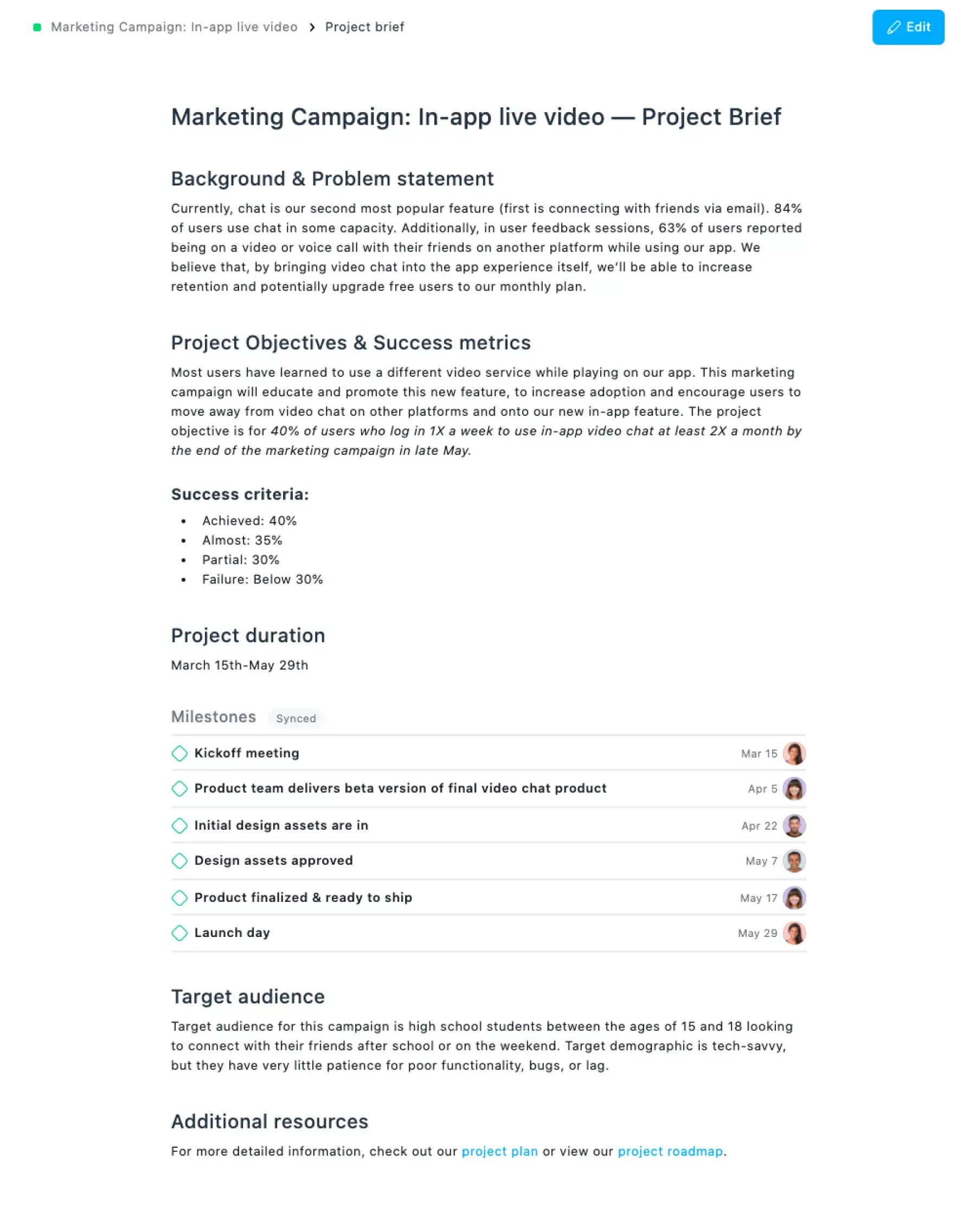
Your project brief outlines your general objectives and how you plan to achieve them. This can serve as a helpful North Star to guide planning sessions.
The most important thing to remember about your project brief is that it's a living document. As you develop your project plan and get input from stakeholders, you can adapt and update your project brief. In general, your project brief should contain a link to your project roadmap, a list of your project stakeholders and their responsibilities (sometimes called a RACI chart), and any other high-level information your team might need.
Avere il controllo e una visione d'insieme dei progetti è essenziale per il team direttivo e ci consente di essere al corrente di ciò che accade.”
4. Hosting a project kickoff meeting
![[Interfaccia utente del prodotto] Progetto di una riunione di avvio su Asana, visualizzazione in stile foglio di calcolo (elenco)](https://assets.asana.biz/transform/9170a22c-5222-47e9-bc10-44edbe56e10e/TG23-web-hero-026-kickoff-meeting-static-2x?io=transform:fill,width:2560&format=webp)
A kickoff meeting is an opportunity to align with your project stakeholders. This is your chance to clarify your project goals and scope, and share any documents you've already put together, like your project roadmap, project brief, or a creative brief for a design team.
To host a successful kickoff meeting, plan to share the documentation you have put together with project stakeholders. Then, host a brainstorming or Q&A session to align on any additional variables, like budget,resources, or final deliverables.
5. Project roadmapping
![[Interfaccia utente del prodotto] Modello di grafico dei traguardi su Asana (vista cronologia)](https://assets.asana.biz/transform/46f9b6dc-a110-4348-9670-7e49f79b897e/TG23-web-hero-003-milestone-chart-static-2x-en?io=transform:fill,width:2560&format=webp)
A project roadmap is a high-level overview of your project's key deliverables and timeline. Project roadmaps are helpful for complex initiatives with many stakeholders because they help the entire project team get on the same page before the project even starts.
Traditionally, project roadmaps are created in Gantt chart-like software, in order to display a general schedule of your project as a horizontal bar chart. To create a project roadmap, use a tool like in Asana to create a rough timeline of your project, adding key milestones or important dependencies.
6. Mapping your project timeline
![[Product ui] Timeline in Asana, Gantt chart-style view (Timeline)](https://assets.asana.biz/transform/79f35737-4e03-4527-91cf-fb88073e11e2/TG23-web-hero-017-timeline-static-2x?io=transform:fill,width:2560&format=webp)
Your project timeline is the order and duration of events during your project lifecycle. Knowing your project timeline helps your team track project success and deliver the right assets on time.
To build a great project timeline, clarify the start and end dates of your project, along with any key milestones. As you continue to build out individual tasks and deliverables, set dependencies among tasks and clarify the start and end dates for each piece of work.
7. Task management
Once your project is officially underway, task management refers to how well you manage your time and your team's time. The best project managers have real-time visibility into what their teams are working on, so they can help them effectively prioritize and execute work.
But you don't have to magically know everything that's happening in your project; instead, use task management software. Task management software is more than a to-do list; it's a way to get a holistic view of all of the work happening in your project.
Con Asana, possiamo vedere l'avanzamento del progetto e i blocchi, oltre ai feedback e alle attività, tutto in un unico posto. Ora riusciamo portare a termine il lavoro in modo più efficiente ed efficace, il che è diventato ancora più importante quando si lavora da casa. Ormai non possiamo più farne a meno!”
8 technical skills all project managers need
Technical skills refer to your knowledge of specific tools and software within project management. Modern project management tools are built to be flexible and easy to use, so these skills aren't hard to learn. Here are the eight technical skills every project manager should know:
Project management software skills
Gantt charts
Kanban boards
Agile management
Workload management
Cost management
Project portfolio management
Change management
1. Project management software skills
Project management softwarehas come a long way from legacy tools that were difficult to use and required a project management professional to implement. But like any tool, even easy-to-use ones, the software you choose takes time to learn and truly master. Make sure the tool you select has a written guide and helpful videos to teach you the ins and outs of how to use it.
Manage projects with one tool2. Gantt charts
![[Interfaccia utente del prodotto] Progetto di lancio del prodotto con diagramma di Gantt su Asana (cronologia)](https://assets.asana.biz/transform/d25dcaf2-e57e-4a6a-8528-0e429f95ff76/TG23-web-hero-025-gantt-chart-static-2x?io=transform:fill,width:2560&format=webp)
Gantt charts are a way to visualize your project as a horizontal bar chart, where each bar represents a piece of work and its length represents the time it will take. Gantt charts help you track:
Dependencies
Real-time project progress
Start and end dates
Traditional Gantt chart technology can be tricky to use and limited in scope, which is why, at Asana, we took the best of Gantt chart technology and created Timeline, a Gantt-chart-like tool that helps you see how all of the pieces fit together.
Il lancio di un album comporta moltissime variabili e Asana ci aiuta a monitorare ogni dettaglio, chi ne è responsabile e quando deve essere completato.”
3. Kanban boards
![[Interfaccia utente del prodotto] Progetto di piani di sprint su Asana (bacheche)](https://assets.asana.biz/transform/9d21e8c7-9627-42eb-bda4-ac321d42c821/engineering-kanban-view?io=transform:fill,width:2560&format=webp)
Another popular type of visual project management is theKanban board. Each column in a Kanban board represents a stage of work, like New, In progress, or Done. Individual work is represented by cards, which move through the columns until they're completed.
Kanban boards tools are a popular visual project management tool for lean project management teams, particularly product, engineering, and software development teams. They're an Agile methodology designed to be adaptable and flexible, adjusting to development needs in real time.
Leggi: La guida per principianti alle bacheche Kanban4. Agile management
Agile management is a lean project management methodology that's particularly popular with product, engineering, and software development teams. Agile operates on a system of continuous improvement and incremental evolution, and it encompasses several lean methodologies, like lean portfolio management, Scrum, and Kanban.
To manage an Agile team, the project manager's job is to coordinate among team members and stay flexible. This can mean changing the project schedule, aligning with teams working on a different project, or staying in touch with effective communication.
5. Workload management
![[Interfaccia utente del prodotto] Gestione delle risorse su Asana (Gestione delle risorse)](https://assets.asana.biz/transform/04f7d02f-1ce7-48dc-91d4-d17f2d3b3f9e/inline-generic-workload-2x?io=transform:fill,width:2560&format=webp)
If you've managed projects before, you know how hard it is to gain clarity on who is working on what, but it doesn't have to be. Workload management helps you measure your team's bandwidth and make sure they aren't over- or under-worked.
There are two steps to using workload management software. First, determine your team's capacity, competencies, and current workload. From there, allocate resources based on individual workload or rebalance workloads as needed.
6. Cost management
In project management, cost management is considering how each task impacts your budget at every stage of the project. Cost management is a key part of project leadership and an important factor in whether your project succeeds.
To manage costs effectively, follow this approach:
Before the project: Define your costs and budget, and ensure all stakeholders understand the financial constraints
During the project: Check in on your spending regularly to make sure you aren't overshooting your budget
After the project: Compare predicted cost vs. actual cost to evaluate your cost management strategies and benchmark for future projects
7. Project portfolio management
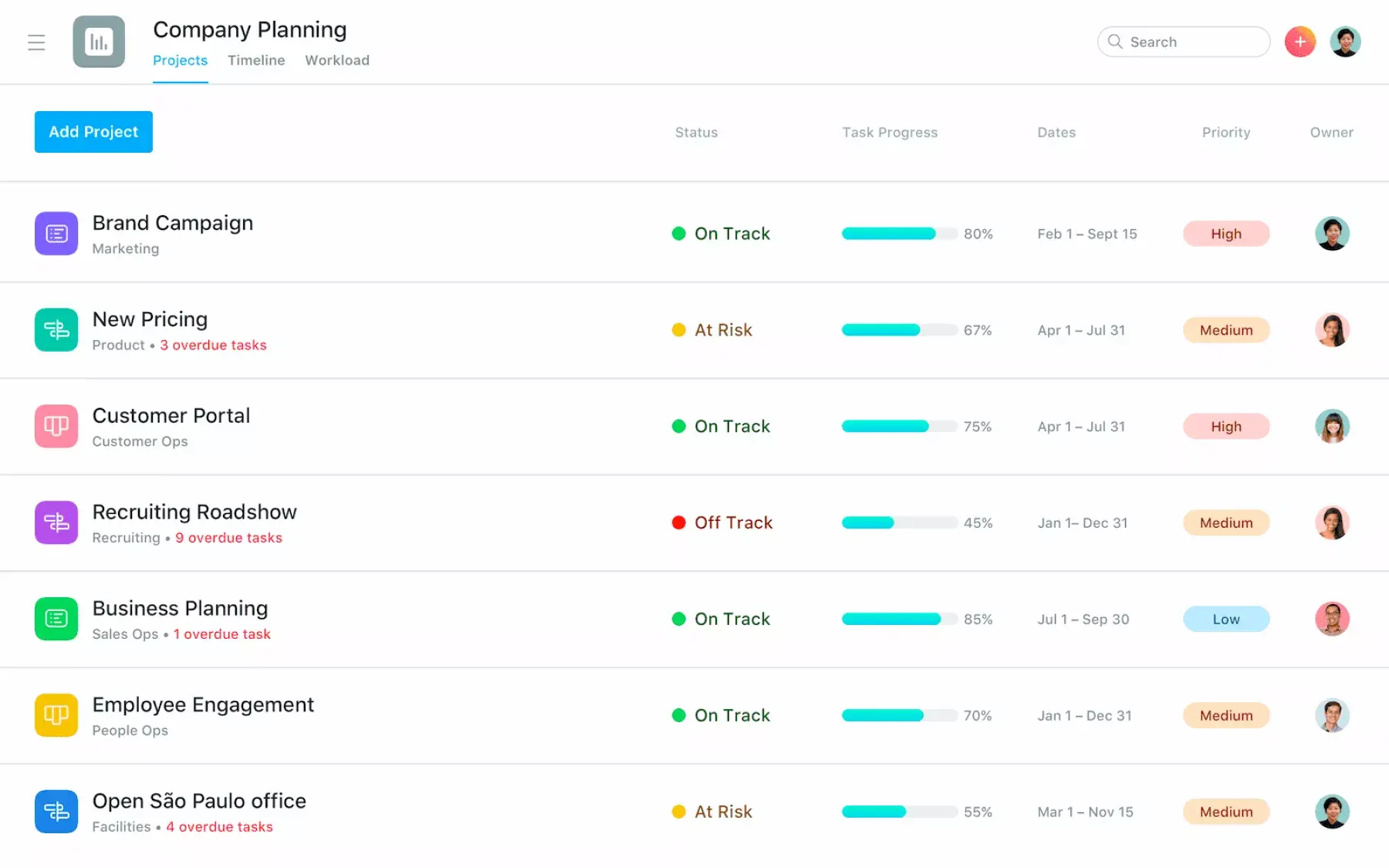
With project portfolio management (PMM), you can get a bird's-eye view of your team's work across multiple projects. Unlike traditional project management, PMM involves working on multiple projects or large-scale initiatives simultaneously. Project portfolio management tools help you get a holistic view of all of your team's work in real-time, so you can connect strategy to execution.
Anche i portfolio sono una funzionalità chiave di Asana per il nostro team. Questo eccellente strumento che riunisce stato, avanzamento e responsabilità consente al nostro team dirigenziale di visualizzare tutti i progetti importanti in un unico posto. Il nostro amministratore delegato controlla ogni giorno il nostro portfolio e aggiunge commenti. Apprezza il fatto di essere in grado di vedere cosa sta succedendo in maniera istantanea.”
8. Change management
If you've ever rolled out a big organizational change, you've likely practiced change management, even if you didn't know it. Change management is the process of introducing organizational change, such as new processes or tools, over a set period to make it easier to adapt.
At Asana, we use the Asana Way of Change, a six-step process developed by our Customer Success team that incorporates proven change management strategies. To learn more, read our guide to change management.
Per un certo periodo di tempo, reagire al lavoro è stato lo standard per il nostro team di creativi. Ma non riusciremo mai a lavorare al meglio senza un processo chiaro.”
How to build your project management skills
Twenty-five skills might feel like a lot, but you don'tt need to master every one. Some, like Agile, are only relevant for specific teams. Others, like organization, become effortless with the right tools.
Here's how to develop your project management skills over time:
Practice on real projects: Challenge yourself to focus on one or two new skills per project, whether that's trying visual project management like Kanban or drafting your first project plan
Take formal courses: The Project Management Institute (PMI) offers courses, learning events, and its Guide to the Project Management Body of Knowledge (PMBOK® Guide)
Learn your tools: Once you've selected a project management tool, take advantage of its training resources, like Asana Academy and the How to Asana series
Build your project management toolkit
If you manage a project, you're a project manager, and you likely already have some key project management skills. The most important thing is to be intentional, listen to your team, and collaborate with your team members.
Project management doesn't need to be complex. Asana was designed specifically to keep project managers organized, with tools, automations, and customizations built to collaborate and coordinate everything from a simple brainstorming session to a full-fledged product launch. Ready to put your skills into practice? Get started with Asana today.
Gestisci i progetti con Asana